
- Agriculture is defined as the growing and/or raising of crops and livestock, whereas marketing refers to the actions involved in transferring things from the point of production to the point of consumption.
- It encompasses the planning, production, transportation, processing, and distribution of agricultural products.
- The goal is to ensure that items reach consumers quickly while satisfying market demands at a reasonable price.
- Agricultural marketing falls under List-II (State List) of the VII Schedule under Article 246 of the Constitution, specifically Entry 28.
CHARACTERISTICS OF AGRICULTURAL-COMMODITIES
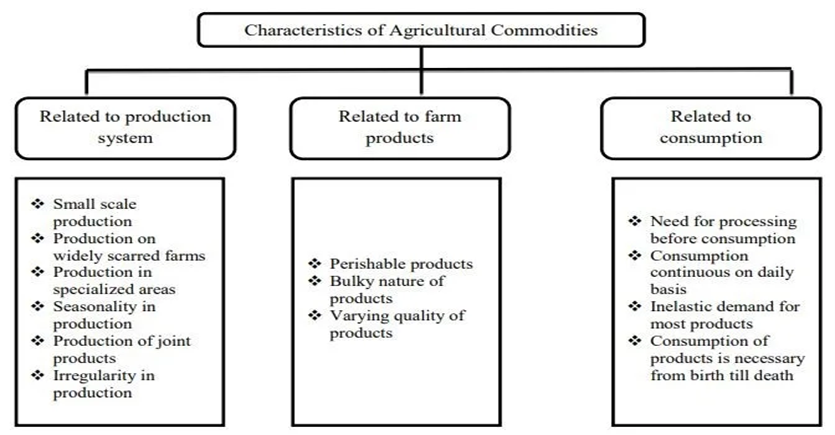
CONCERNS FOR INDIA’S AGRICULTURE MARKETING
- Insufficient Infrastructure: Poor transportation, storage, and cold chain facilities result in large post-harvest losses and inefficient distribution.
- Fragmented Markets: The lack of organized markets and the reliance on various middlemen raises expenses and diminishes farmers’ profit margins.
- Price Fluctuations: Market volatility frequently results in uncertain pricing for farmers, causing income instability.
- Limited Market Access: Small-scale farmers struggle to reach remote or organized markets, limiting their ability to sell at reasonable prices.
- Lack of Market Information: Farmers frequently lack timely information on prices, demand trends, and quality requirements, limiting their ability to make informed decisions.
- Limited financing and Financial Support: The inability to obtain inexpensive financing for transportation, storage, and processing stifles growth and profits.
- Inadequate Value Addition: Low investment in processing and value addition results in the export of raw, unprocessed goods at lower prices.
KEY HIGHLIGHTS OF THE NATIONAL POLICY FRAMEWORK
- It has proposed the constitution of an Empowered Agricultural Marketing Reform Committee of State Agricultural Marketing Ministers to push agriculture marketing reforms.
The success of the GST Council in harmonizing tax policies across states and creating a unified tax regime serves as a model for this new initiative.
- Composition of Committee: The empowered committee may be chaired by the agriculture minister of any state on rotational basis with agriculture ministers of the remaining states as members.
- Supply Chain Reforms: It highlighted the need for private wholesale markets, direct purchases by processors and exporters, and the declaration of warehouses and cold storage as deemed market yards.
These measures are crucial for reducing the intermediaries in the supply chain and ensuring that farmers receive better returns for their produce.
- Price Insurance Scheme: It proposes a price insurance scheme along the lines of the Pradhan Mantri Fasal Bima Yojana (PMFBY) to protect farmers from price crashes.
This scheme aims to stabilize farmers’ incomes, encourage the adoption of modern agricultural practices, and ensure the flow of credit to the agriculture sector.
GOVERNMENT INITIATIVES TO REFORM AGRICULTURAL MARKETING IN INDIA
- PM-AASHA (Pradhan Mantri Annadata Aay SanraksHan Abhiyan) 2018: A scheme to ensure farmers get remunerative prices through Price Support, Price Deficiency Payment, and Private Procurement Schemes.
- Agriculture Produce Market Committee (APMC) Reforms: Encouraging states to amend APMC Acts for direct selling and private market participation to reduce middlemen.
- E-NAM (National Agriculture Market): An online platform integrating mandis to enable transparent trading and better price discovery.
- Kisan Rail Scheme: Dedicated trains for transporting perishable goods, improving market access and reducing transportation costs.
- Agricultural Infrastructure Fund (AIF): Providing financial support for developing storage, processing, and cold storage facilities.
- One Nation, One Market: Aiming for seamless interstate trade by eliminating barriers and strengthening the E-NAM platform.
- FPO (Farmer Producer Organization) Promotion: Supporting farmer cooperatives to improve bargaining power and market linkages.
- Support for Agri-Startups: Encouraging innovation and new market solutions in the agriculture sector through financial and mentorship support.
- Minimum Support Price (MSP) Policy: The MSP system aims to provide a safety net for farmers by ensuring that the price they receive for their crops is above the cost of production.
