LNG
- Natural gas that has been cooled to a liquid condition, roughly -260°F (-162°C), is known as liquefied natural gas (LNG), which makes it safer and easier to transport and store.
- Natural gas is essential to India’s shift to greener energy sources since it is a more cost-effective and cleaner substitute for traditional hydrocarbons like coal and oil.
- Methane makes up 70–90% of natural gas, making it the main component.
- According to the IEA, Natural gas accounts for about a quarter of global electricity generation.
- Presently in India the share of natural gas in the energy basket is 6.7%.
- The top natural gas producing countries are the United States, Russia and Iran.
MAJOR APPLICATIONS
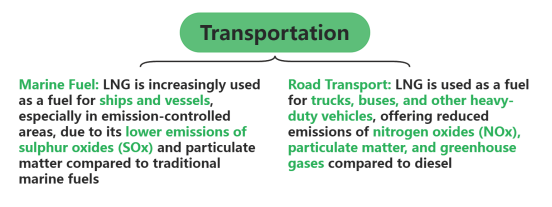
TRANSPORTATION
INDUSTRIAL APPLICATIONS
- Power Generation: LNG is used in gas-fired power plants to generate electricity, providing a cleaner alternative to coal or oil-fired power plants with lower emissions of pollutants.
- Heating and Cooling: LNG can be used in industrial processes for heating and cooling applications, such as in manufacturing, food processing, and refrigeration.
ENERGY STORAGE AND BACKUP
- Renewable Energy Integration: LNG can complement renewable energy sources like wind and solar by providing backup power when renewable generation is intermittent or unavailable.
RELATED CHALLENGES
- High Costs: Building LNG liquefaction and regasification facilities is expensive. Additionally, the transportation process itself requires specialised cryogenic (super cold) carriers, further adding to the cost.
Countries like China have successfully integrated LNG in commercial vehicles, but India faces challenges such as limited availability of LNG vehicles, higher initial costs, and a lack of financing and retail networks for LNG.
- Environmental Impacts: While cleaner than coal, LNG production and transportation still have some environmental impact, such as methane emissions.
Methane is the second-most abundant GHG after CO2. Although methane dissipates faster than CO2 in the atmosphere, it has a much stronger planetary warming effect.
- Safety Concerns: LPG is highly flammable and can pose significant safety risks if not handled properly. Improper storage, handling, or use can lead to leaks, fires, or explosions.
SMALL-SCALE LNG
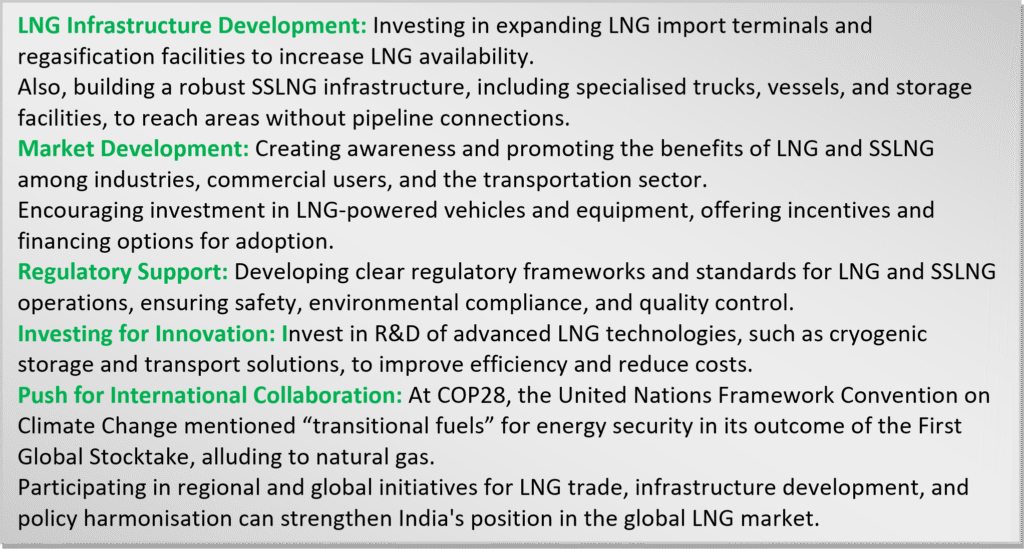
- SSLNG involves liquefying and transporting natural gas on a smaller scale, catering to areas without pipeline connections using specialised trucks and vessels.
- Starting from large-scale LNG import terminals, SSLNG can supply LNG directly to consumers via cryogenic road tankers or small vessels, either as a liquid or regasified for traditional uses.
- It will lead to reduced dependency on costly gas imports, especially if it replaces a significant portion of diesel consumption, leading to substantial foreign exchange savings.
- It also promotes cleaner energy and supports India’s transition towards sustainable fuel sources.
At GAIL (India) Ltd.’s Vijaipur complex in Madhya Pradesh, the Union Minister for Petroleum and Natural Gas recently opened India’s first small-scale liquefied natural gas (SSLNG) facility.
This development is a component of the government’s larger plan to encourage the use of natural gas in a variety of industries and raise its percentage to 15% of the nation’s primary energy mix by 2030.
WAY FORWARD