
INDIAN LABOUR PRODUCTIVITY STATUS AS PER THE ILO DATA
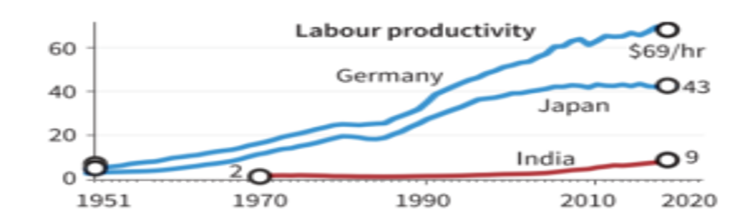
- India: India’s hourly output stands at $8.47. Indians work an average of nearly 48 hours per week.
- France: France’s hourly output stands at $58. Average workweek is around 30 hours per week.
YOUNG INDIA’S WORKING HOURS
- Time Use Survey in India data shows that young Indians aged 15-29 currently work around 7.2 hours a day in rural areas and 8.5 hours a day in urban areas.
- Mr. Murthy’s justification for lengthy work hours relies on the fact that long work hours have increased productivity in Germany and Japan.
- Following World War II, workers in Germany and Japan were urged to work longer hours each day in order to increase economic production. The typical annual working hours were 2,200–2,400 hours, or 8.3–9 hours per day, with a five-day work week that did not include vacations.
- A 70-hour work week, however, equates to 14 hours per workday. This would surpass the achievements made by Germany and Japan in the years following World War II.
ARGUMENTS IN FAVOR OF ’70 HOURS WORK WEEK’
- Enhanced Productivity: Proponents contend that since more time would be spent on activities and projects, a longer workweek would perhaps lead to increased productivity. Increased productivity is a result of longer working hours in Germany and Japan.
- Higher Economic Growth: Extended work hours have the potential to enhance economic growth by stimulating productivity and creativity. It can assist India in achieving its $5 trillion economic target.
- Increased Global Competitiveness: Longer work hours could help Indian professionals stay competitive in the global job market in an increasingly globalised environment. The Indian financial sector used to be able to operate around the clock and meet international standards.
- Potential for higher tax revenues for the government: Increased economic activity and higher incomes due to longer working hours result in greater tax revenues. This can be used for public services and infrastructure development.
- Opportunity for Skill Development: Individuals can achieve mastery in one’s chosen field by investing extra number of hours at work. For Ex- Out of the 70 hours, one can assign 40 hours to his/her professional responsibilities and set aside 30 hours for personal skill enhancement.
- Leveraging the Demographic Dividend for Nation Building: India needs a dedicated labour force where young individuals are willing to put in 70 hours of work per week for the service of nation-building.
ARGUMENTS AGAINST THE ’70 HOURS WORK WEEK’
- Decline in productivity with Long Working Hours: Studies reveal that productivity starts to decrease dramatically around 50 hours worked per week and then starts to diminish even more at 55 hours. Germany and Japan reduced work hours to 1,400–1,600 hours annually, which resulted in even greater productivity gains.
The nations that are most productive globally have the least number of working weekdays.
- Burnout and Mental Health: 70 hours a week workers are more likely to burn out, experience high levels of stress, and have mental health issues. Working long hours can be detrimental to one’s health and work-life balance.
- Increased healthcare costs due to stress-related issues: Longer hours can result in higher healthcare costs, as stress-related health problems become more prevalent.
- Negative Effect on Family Life: Long work hours can make it more difficult to meet personal and family obligations, strain relationships within the family and disturb the work-life balance.
- Diminished Creativity and Innovation: Overworked People frequently exhibit less creativity and innovation. Tiredness can hinder one’s capacity for original thought and problem-solving.
- Work Quality: Longer hours do not always translate into better work. Tired employees are more prone to make mistakes and do subpar work.
- Exacerbation of gender Inequalities: Extended work hours may have a disproportionate impact on women, who often shoulder greater caring and home obligations, hence exacerbating gender inequalities.
- Danger of Exploitation: Employers may take advantage of a culture of extended work hours, which could result in unpaid overtime, subpar working conditions, and abuses of workers’ rights.
- Negative Impact on the Community and Society: Long work hours can reduce participation in the community and society, which can have a negative impact on volunteering work and social cohesiveness.
WAY FORWARD FOR INCREASING PRODUCTIVITY WITHOUT INCREASING THE WORK HOURS
- Technological Adoption: We must invest in modern technologies and automation to streamline processes and improve productivity.
- Skills Enhancement: Skill India Mission must be implemented properly to provide skill training and education to workers.
- Upgradation of Infrastructure: We must develop better transportation infrastructure to reduce commuting time and increase accessibility to workplaces.
- Fostering Innovation: We must encourage research and development (R&D) activities to drive innovation, leading to improved products and services and increased productivity.
