
BAD BANK
- In order to liquidate the transferred assets, bad banks are asset reconstruction firms that purchase, oversee, and retrieve non-performing assets (NPAs) from commercial banks.
- It gives banks a safety net so they can get rid of problematic loans and concentrate on making better loans.
BENEFITS
- The centralization of NPA management by bad banks can improve asset resolution efficiency and streamline operations.
- Originating banks might release capital retained as provisions against these assets by moving NPAs to a bad bank. This may result in more credit being extended to more deserving clients.
- The financial stability and overall capital buffers of the original banks can be improved by government support for failing institutions.
DRAWBACKS
- Simply shifting the burden within the public sector through the transfer of poor assets to a government-backed business may result in taxpayer liability for any losses incurred.
- Government bailouts may deter banks from being cautious in their lending policies, which could result in a recurrence of the same problems later on.
PRESENT-DAY DIFFICULTIES FOR BAD BANKS
- Price Discovery: Bad banks often face difficulties in pricing bad loans and determining future liabilities.
- Finding Buyers: Selling portfolios of distressed assets can be challenging, especially without established market mechanisms or precedents.
Weak economic conditions can further depress asset values and reduce the pool of potential buyers.
SWISS CHALLENGE METHOD
- The Swiss challenge method is a public procurement process that allows private companies to bid on government contracts. The method is used for projects such as roads, ports, and railways, or for services provided to the government.
- The RBI allowed banks to use Swiss Challenge technique for the selling of NPA accounts it involves:
- Initial Offer: A buyer submits an offer to purchase an NPA account.
- Invitation for Counter-Bids: If the initial offer is in cash and exceeds the bank’s minimum threshold, the bank invites counter-bids.
PREFERENCE ORDER
- Asset Reconstruction Companies (ARCs): ARCs with the largest stakes in the bank are given priority.
- First Bidder: If no ARCs participate, the initial bidder is preferred.
- Highest Bidder: During the counter-bid process, the highest bid is selected.
NARCL
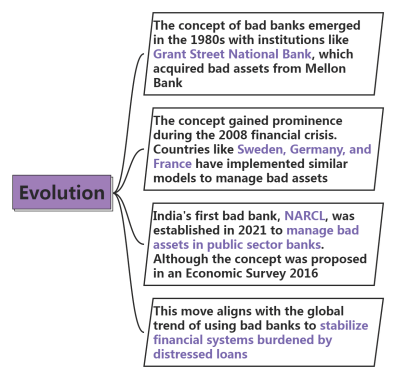
- Designed as a “bad bank,” NARCL aims to cleanse the financial system of distressed loans, thereby stabilizing banks and fostering a healthier economic environment.
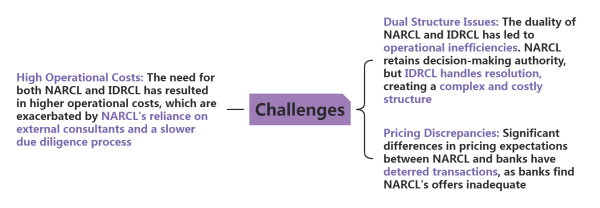
- Under the new structure NARCL acquires and aggregates bad loan accounts from banks. India Debt Resolution Co. Ltd (IDRCL) handles the resolution process, operating under an exclusive arrangement with NARCL.
ROLE OF NARCL
- Purchase bad loans from commercial banks. Manage these distressed assets.
- Sell them in the market through bidding methods like Swiss Challenge to recover funds and liquidate the transferred assets.
- Funding and Ownership: NARCL’s acquisition strategy involves paying 15% of the agreed loan value in cash and the remaining 85% in government-backed security receipts.
- State-owned banks hold a 51% stake in NARCL, with the remaining stake owned by private banks.
CHALLENGES FOR NARCL
POTENTIAL SOLUTIONS FOR NARCL’S CHALLENGES
- Combining IDRCL and NARCL could streamline operations, reduce costs, and enhance efficiency by eliminating duplicative functions.
- Implementing performance-linked incentives could attract skilled professionals and improve the effectiveness of asset resolution.
- Investor-friendly policies to facilitate domestic and foreign investor participation in asset resolution.
- Foster a secondary market for distressed assets to improve liquidity and price discovery.
