
ABOUT BALANCED FERTILIZATION
A technique used in agriculture called balanced fertilisation aims to give plants the ideal ratios of nutrients for strong, healthy growth and development.
ESSENTIAL NUTRIENTS
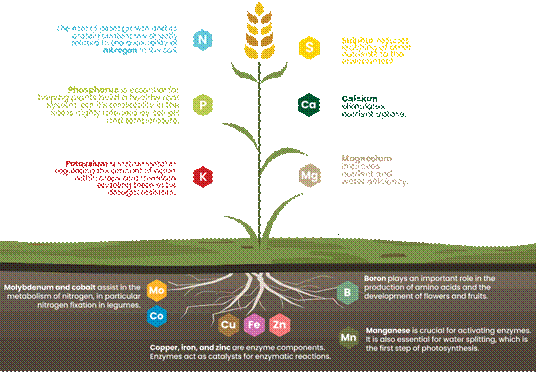
- Primary Nutrients: The three most important nutrients that are required in greater amounts are nitrogen (N), phosphorus (P), and potassium (K). They are essential to the structure, synthesis of energy, and general health of plants.
- Secondary Nutrients: While not as necessary as primary nutrients, sulphur (S), calcium (Ca), and magnesium (Mg) are nonetheless necessary in smaller quantities.
- Micronutrients: Even though they are required in very minute amounts, trace elements including iron (Fe), zinc (Zn), copper (Cu), manganese (Mn), boron (B), and molybdenum (Mo) are nevertheless essential for certain plant processes.
RIGHT PROPORTION
- Balanced fertilisation emphasises supplying these essential nutrients in the correct ratios based on several factors:
- Soil Type: Different soil types have varying levels of inherent nutrients. Testing the soil reveals its nutrient profile, guiding fertiliser selection and application rates.
- Crop Requirements: Different crops have specific nutrient needs at different stages of growth. For example, legumes might require more nitrogen for nitrogen fixation, while fruits might benefit from additional potassium for better quality.
BENEFITS ASSOCIATED WITH BALANCED FERTILISATION
CHALLENGES RELATED TO BALANCED FERTILISATION
- Price Distortions: Urea, a single-nutrient nitrogen fertiliser, is heavily subsidised by the government, making it cheaper than other fertilisers like DAP (diammonium phosphate) containing phosphorus and MOP (muriate of potash) containing potassium.
This incentivises overuse of urea and neglects other crucial nutrients.
- Distorted Fertiliser Pricing Hinders Potash Use: The current system for setting fertiliser prices fails to consider market forces, leading to imbalances. For example, the price of Muriate of Potash (MOP), a key source of potassium, is too high for both farmers using it directly and fertiliser companies including it in blends.
This discourages MOP use, contributing to widespread potassium deficiencies in Indian farms.
- Soil Testing Infrastructure: Lack of adequate soil testing facilities in the rural and remote areas of India, makes it difficult for farmers to access them for balanced fertilisation.
Even if tests are done, interpreting the results and translating them into fertiliser recommendations requires proper training and mechanism for both farmers and extension workers.
- Farmer Awareness and Education: Many farmers lack awareness about soil testing and the specific needs of their crops.
Traditional practices and limited knowledge mostly hinders adoption of balanced fertilisation techniques .
It is due to the lack of precise fertiliser application techniques resulting in issues of over-fertilisation and under-fertilisation alongwith limited focus on micronutrients.
- Limited Success of Past Schemes: The Nutrient-Based Subsidy (NBS) scheme, meant to encourage balanced use, failed because it didn’t address urea pricing. Urea consumption continued to rise despite NBS.
INDIA’S STEPS TO ACHIEVE BALANCED FERTILISATION
- Integrated Nutrient Management (INM): It recognises the limitations of relying solely on chemical fertilisers or organic matter.
It advocates for a holistic approach that combines:
- Chemical Fertilisers: Provide essential nutrients like NPK.
- Organic Matter: Improves soil health, water retention, and nutrient availability. This includes manure (cow dung), compost, and crop residues (dhaincha crop).
- Crop Rotations: Introducing diverse crops helps break pest and disease cycles and improves nutrient utilisation.
- Customising Fertilisers Using Technology: Customised fertilisers are multi-nutrient carriers containing macro and micronutrients for satisfying crop needs that are site-specific and validated by scientific crop models.
It is the emerging concept based on the balanced nutrient fertilisation approach to address the crops’ multiple nutrient needs.
- In Israel, some remarkable steps are being followed: High-resolution soil mapping and its integration with Geographic Information Systems (GIS) to create user-friendly maps and fertiliser application recommendations for farmers.
Advanced laboratory analyses go beyond basic NPK tests and delve into micronutrients, organic matter content, and cation exchange capacity (CEC).
- Soil Test Crop Response (STCR): Tailors fertiliser recommendations based on specific soil type, crop variety, and climatic conditions.
It considers nutrient uptake by the crop and soil nutrient availability.
- Diagnosis and Recommendation Integration System (DRIS): Analyses plant tissue for nutrient ratios (e.g., N/P, N/K) and compares them to established optimal ratios for high yields.
Deficient nutrients are then supplemented through top dressing. (More suitable for long-duration crops).
- Farmer Education and Training: Equipping farmers with the knowledge and skills to implement these approaches effectively.
- Improved Market Access: Ensuring the availability of customized fertilizers and micronutrients at reasonable prices.
- Policy and Subsidy Reforms: Encouraging the use of balanced fertilizers through targeted subsidies and promoting sustainable practices.
- Continued Research and Development: Developing new technologies and crop-specific nutrient management solutions.
AGRICULTURAL MARKETING
