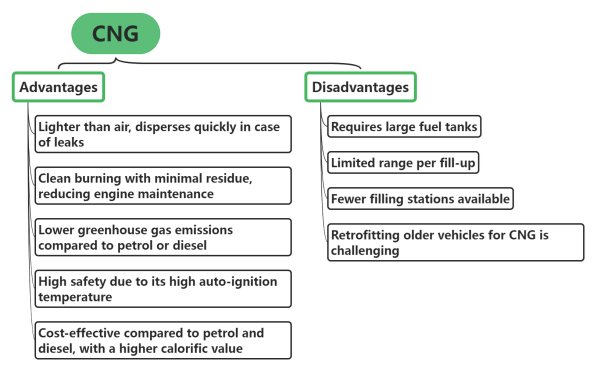
- Compressed natural gas, or CNG, has been compressed at high pressure to reduce its volume in fuel tanks.
- It is typically compressed to less than 1% of its size at atmospheric pressure at pressures between 200 and 250 kg/cm².
- Unlike LPG, which is a mixture of compressed propane and butane, CNG primarily consists of 80 to 90% methane in a gaseous state.
- The distinction between CNG and LNG lies in their physical states: CNG exists as a gas, whereas LNG exists as a liquid which is then regasified for usage.