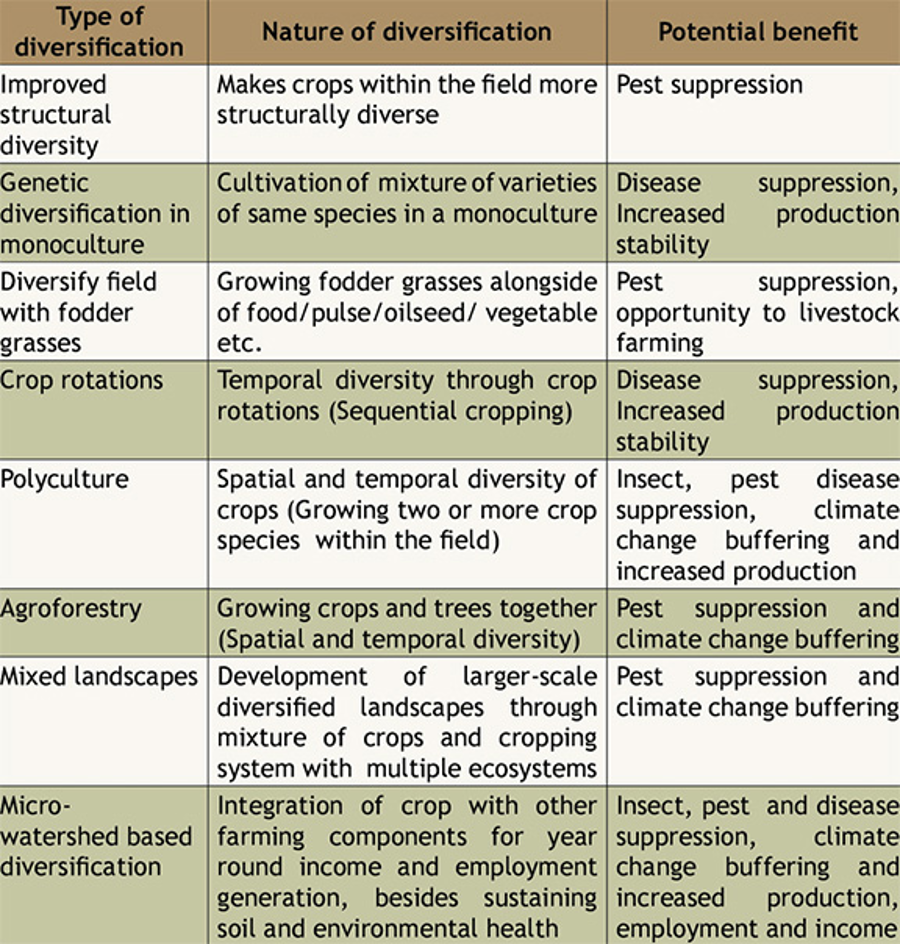
- Crop diversification is the process of cultivating multiple crops on a plot of land or in a farming system as opposed to depending just on one crop.
- The objectives of this farming approach are to lower crop failure risk, improve soil health, strengthen resistance to pests and diseases, and raise overall farm productivity and sustainability.
ADVANTAGES
- Lowers Risks: Farmers can diversify their crop production in drought-prone areas by cultivating both water-intensive crops, such as rice or vegetables, and drought-tolerant kinds, such as sorghum or millets.
Drought-tolerant crops can survive in the absence of water, guaranteeing a certain amount of yield in spite of unfavourable circumstances. - Enhances Soil Health: Leguminous crops, such as peanuts or soybeans, may fix nitrogen in the soil, which is beneficial for later crops, like wheat or maize, which need rich soil to flourish to their full potential.
- Market Opportunities: Farmers can take advantage of specialized markets and new trends by diversifying their crop offerings.
For instance, farmers have the chance to diversify into organic farming due to the growing market demand for organic produce, which frequently fetches better prices than crops cultivated conventionally. - Pest and Disease Management: Intercropping or mixed cropping, a form of crop diversification, can help manage pests and diseases.
For instance, planting marigold flowers alongside vegetable crops can deter pests, reducing the need for chemical pesticides and promoting natural pest control mechanisms.
- Source of Biofuels: Crops like Jatropha and Pongamia are potential sources for biofuel production. This can offer farmers additional income opportunities and contribute to India’s energy security.
CHALLENGES

- Market Risks and Limited Opportunities: Farmers are often hesitant to switch from established crops like rice and wheat (which have assured government support through MSP) to lesser-known crops.
These alternatives may have fluctuating market prices or limited demand, leading to potential income loss.
- Financial Constraints: Diversifying crops can require additional investment in seeds, equipment, and even acquiring new knowledge about cultivation practices.
Smallholder farmers, who make up a significant portion of India’s agricultural sector, may not have the financial resources to readily adopt these changes.
Also, Millets like Jowar, Ragi, and Bajra are gaining traction due to their high nutritional value and ability to thrive in marginal lands.
However, creating a robust market for these requires investment in processing facilities to convert them into consumer-friendly products like ready-to-eat mixes or breakfast cereals.
- Lack of Infrastructure and Storage: Perishable, diversified crops often require specialised storage and transportation facilities that may not be readily available in rural areas.
Without proper infrastructure, these crops can spoil quickly, leading to wasted produce and lost income.
- Clash With Dietary Habits: Crop diversification in India, particularly in regions where rice and wheat are staples for a significant portion of the population, could potentially disrupt the established market dynamics and consumption patterns prevalent in these areas.
INDIA’S REQUIREMENTS TO EMPHASIZE CROP DIVERSIFICATION
- Crop diversification refers to the practice of growing a variety of crops on a farm instead of focusing on a single crop.
- The Green Revolution in India, through the introduction of high-yielding rice and wheat varieties, resulted in a substantial increase in food output, effectively reducing hunger and malnutrition.
- However, the monoculture of these crops led to a decrease in crop variety, causing the decline of traditional, region-specific strains and a loss of genetic diversity.
- For instance, India has lost over 100,000 traditional rice varieties since the 1970s due to the Green Revolution’s impact.
- Therefore, there is a need to shift towards crop diversification to promote sustainable agriculture.
GOVERNMENT MEASURES REGARDING CROP DIVERSIFICATION
- Crop Diversification Program: The Department of Agriculture & Farmers Welfare (DA&FW) has been implementing the Crop Diversification Program (CDP) since 2013-14, as part of the Rashtriya Krishi Vikas Yojana (RKVY), specifically targeting the Original Green Revolution States- Haryana, Punjab, and Western Uttar Pradesh.
This initiative aims to shift focus from water-intensive paddy cultivation to alternative crops such as pulses, oilseeds, coarse cereals, nutri cereals, and cotton.
- Mission for Integrated Development of Horticulture (MIDH): It is a Centrally Sponsored Scheme for the holistic growth of the horticulture sector covering fruits, vegetables, root & tuber crops, mushrooms, spices, flowers, aromatic plants, coconut, cashew, cocoa and bamboo.
- Increase in MSP for Kharif Crops: The Cabinet Committee on Economic Affairs (CCEA) has approved an increase in the Minimum Support Prices (MSP) for all mandated Kharif crops for the Marketing Season 2023-24.
- Mera Pani-Meri Virasat Scheme (Haryana): It offers financial aid to farmers transitioning from paddy cultivation to water-saving alternatives like pulses, oilseeds, millets, and vegetables.
WAY FORWARD